
A full body MRI is a highly advanced imaging scan that gives us a look at your entire body, from head to toe. Using powerful magnets and radio waves, it creates incredibly detailed pictures of your organs, soft tissues, and bones. Think of it as a proactive health screening tool, designed to give you a comprehensive baseline of your internal health and, in some cases, spot potential issues long before you'd ever feel any symptoms.
So, What Exactly is a Full Body MRI?
Let’s use an analogy. Imagine your body is a complex city. If you have a specific problem, like knee pain, your doctor might order a standard MRI. That’s like sending a specialist surveyor to inspect one particular building in minute detail. A full body MRI, on the other hand, is like conducting a detailed aerial survey of the entire city. It creates a complete map of all the major structures, from your brain right down to your pelvis.
This scan provides a panoramic snapshot of your internal health, going far deeper than a routine check-up ever could. It’s not meant to diagnose a problem you already know about; its real power is in searching for the unknown. The main goal here is early detection and prevention, offering you a deep look inside your body to identify potential concerns that might otherwise go completely unnoticed.
To give you a quick overview, here are the key features of the scan:
Full Body MRI at a Glance
This table breaks down the essential aspects of a full body MRI, giving you a clear, concise summary of what the scan involves and what it's for.
This high-level view helps frame the scan's role in a modern, proactive approach to health and wellness.
Who is This Scan For?
A full body MRI isn't a replacement for standard screenings like mammograms or colonoscopies, but it can be a really valuable tool for certain people. It’s often considered by:
- Proactive Individuals: Those who want a deep, data-driven understanding of their current health to make more informed lifestyle choices.
- People with a Family History of Illness: If certain cancers or hereditary conditions run in your family, a scan can offer extra peace of mind or early insight.
- Anyone Seeking a Health Baseline: Creating a detailed internal map of your body is incredibly useful for tracking any changes over time with future scans.
The growing interest in proactive health has brought advanced imaging like this into the mainstream. In fact, the UK whole body imaging market was valued at around USD 1.36 billion, with MRI scans making up the largest share at 41.41%. This market is set to grow, which shows a clear trend towards people using this kind of technology for ongoing health monitoring.
A full body MRI is fundamentally different from a diagnostic scan. Its purpose is not to investigate symptoms you already have, but to offer a panoramic view of your health, potentially flagging concerns you weren't aware of.
The Core Purpose: Proactive Health Monitoring
The real value of this scan lies in its comprehensive scope. By examining all your major organs and systems in one go, it helps build a truly holistic picture of your health.
For anyone serious about taking control of their wellbeing, understanding what different screenings can offer is vital. You might find our guide on what a comprehensive full body checkup involves useful to see how this scan fits into a wider health strategy. This proactive approach empowers you with information, shifting the focus from simply reacting to illness to actively maintaining your wellness.
Your Step-by-Step Guide to the MRI Procedure
Knowing what to expect can take the mystery out of a medical appointment, and a full-body MRI is a surprisingly straightforward process. We’ll walk you through every step, from the moment you arrive to when the scan is complete, so it feels less like a clinical test and more like a manageable part of looking after your health.
When you get to the clinic and check in, you’ll be shown to a private changing area. Here, you’ll be given a comfortable medical gown to change into and asked to remove all metal objects. This part is absolutely crucial because the MRI machine is essentially a giant, powerful magnet. Things like jewellery, watches, hearing aids, and even some cosmetics containing metallic flecks have to come off to ensure your safety and keep the scan images crystal clear.
Preparing for the Scan
Just before you go into the scanner room, a radiographer will sit down with you and go through a final safety checklist. This is a vital conversation where they’ll confirm you don’t have any internal metal, like pacemakers, aneurysm clips, or certain surgical screws, which could be dangerous inside a strong magnetic field. They’ll explain everything that’s about to happen and answer any last-minute questions you have, making sure you feel completely at ease.
This careful preparation is all about creating a safe, controlled environment to get the best possible results. The proactive approach to health screening, as shown below, starts with this baseline prep before moving on to detection and a deeper understanding of what the images reveal.
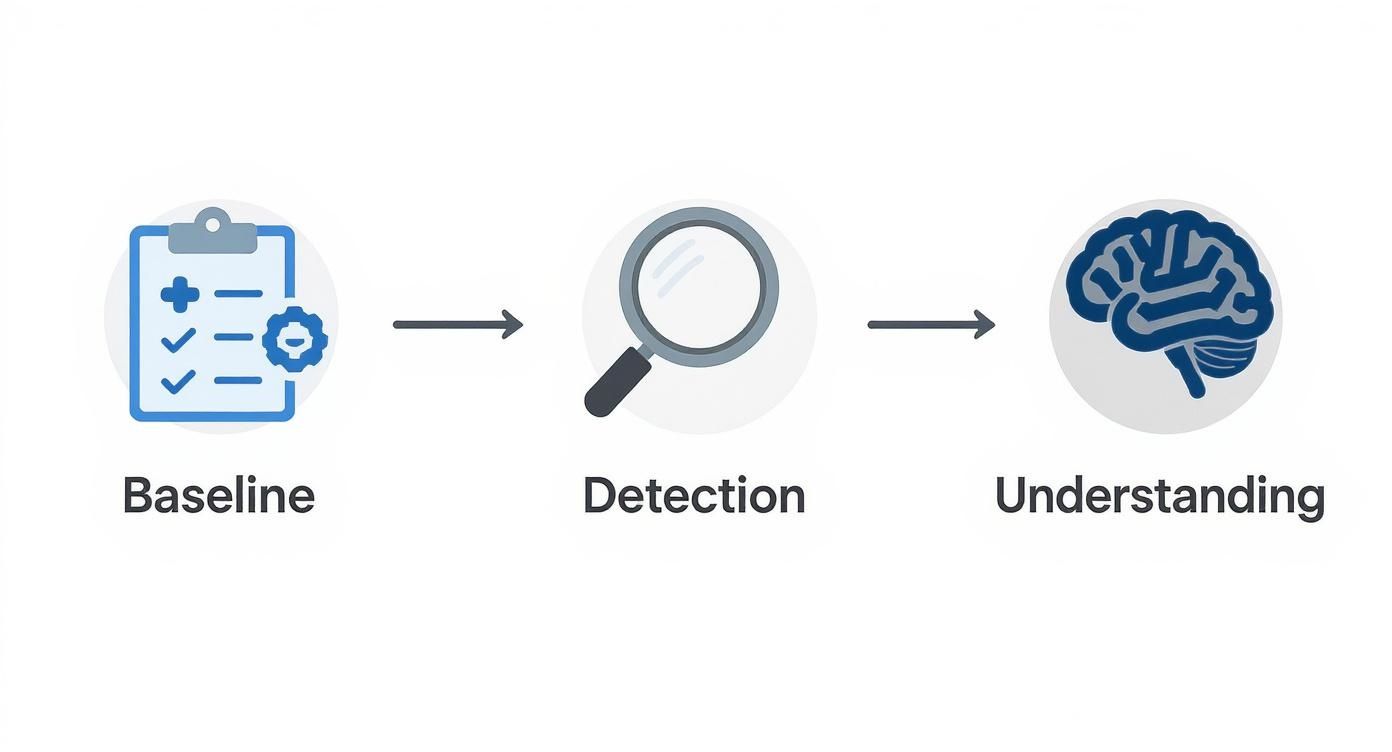
This simple flow shows how each stage builds on the last, turning detailed imaging data into genuinely useful health insights.
Inside the MRI Scanner
Once you’re ready, the radiographer will lead you to the MRI machine. It’s a large, tube-shaped scanner with a padded bed that slides smoothly into the centre. They'll help you get comfortable on the bed, and for a full-body MRI, the bed will move slowly through the scanner, capturing images of different parts of your body in sequence, from your head and neck right down to your abdomen and pelvis.
You’ll be given headphones or earplugs to block out the noise and an intercom so you can talk to the radiographer, who will be watching everything from an adjacent room. You’ll also have a call button, so you can get their attention immediately if you need anything at all.
A key part of a successful scan is staying as still as possible. Even tiny movements can blur the images—think of it like trying to take a photo with a slow shutter speed. The radiographer will give you clear instructions, like when to hold your breath for a few seconds, particularly when they’re scanning your abdomen.
The machine makes a series of loud tapping, clanking, and humming sounds, which can be a bit surprising at first but are perfectly normal. It’s just the sound of the magnetic fields switching on and off to create the images. Although it's noisy, the scan itself is completely painless—you won’t feel a thing. A full-body scan usually takes between 60 and 90 minutes. While that might sound like a long time to lie still, many people use it as a chance to relax, meditate, or even drift off for a bit. This technology is especially good for looking at soft tissues in detail, which is why we’ve explored its use in our guide to understanding a brain MRI scan.
The Role of Contrast Dye
For some targeted MRI scans, a special contrast dye is injected to make certain tissues or blood vessels show up more clearly. However, one of the big advantages of many modern screening full-body MRIs is that they are often performed without contrast. This means you don’t need an injection and it removes the small risk of an allergic reaction to the dye. It’s always a good idea to confirm with your provider whether contrast will be part of your specific scan.
What a Full Body MRI Can and Cannot Detect
A full body MRI is like a high-definition survey of your internal anatomy, giving you a detailed picture that many other screening methods simply can't match. Its biggest strength is seeing soft tissues with incredible clarity. But it's crucial to understand what this powerful scan is brilliant at finding—and just as importantly, what it’s not designed for. This helps set the right expectations from the start.
Think of it as a scout sent into your body to map out the terrain. This scout is fantastic at spotting larger structures and changes in your solid organs, giving you invaluable information that could lead to early intervention.

What a Full Body MRI Excels at Finding
The scan is especially good at assessing a wide range of anatomical structures and potential issues before they cause symptoms. Its detailed imaging helps clinicians spot problems that might otherwise go completely unnoticed.
Here are a few key areas where a full body MRI really shines:
- Solid Organ Health: It gives crystal-clear images of organs like the liver, kidneys, spleen, and pancreas. This makes it possible to detect tumours, cysts, or early signs of conditions like fatty liver disease.
- Musculoskeletal System: The scan can pick up on degenerative spine issues, such as herniated discs, as well as joint inflammation and even bone tumours anywhere in the body.
- Vascular Abnormalities: It can spot problems within your blood vessels, like aneurysms (dangerous bulges in a vessel wall) in the brain or aorta, which often have no symptoms until they become critical.
- Early Signs of Inflammation: An MRI can reveal inflammation in tissues and organs, which can be an early red flag for various conditions, from arthritis to certain organ-specific diseases.
The immense potential of this technology for proactive health is backed by major research. Take the UK Biobank imaging project, which successfully completed over 100,000 whole-body MRI scans—the largest study of its kind in the world. This huge dataset is helping researchers investigate how conditions like cancer and heart disease begin with unbelievable precision.
Understanding the Scan’s Limitations
While it’s an incredible piece of technology, a full body MRI isn't an all-seeing eye. It's a specific tool with specific limitations, and it’s vital to understand that it doesn’t replace the standard screening tests your GP recommends.
A key thing to remember is that its effectiveness varies depending on the type of organ. The scan finds it difficult to get clear images of hollow or moving organs.
A full body MRI is not a universal cancer screen. While it can detect tumours in many solid organs, it is not a substitute for guideline-recommended screenings like mammograms, colonoscopies, or cervical screenings.
These established tests are designed specifically to find the very early-stage changes that a broad-scope MRI might miss. Here’s a quick rundown of what the scan generally cannot detect well:
- Hollow Organ Issues: It’s less effective for looking at the stomach, bowel, or bladder. Air and movement inside these organs can blur the images, meaning things like early-stage colon cancer or stomach ulcers would likely not be seen.
- Very Small Lesions: Extremely tiny abnormalities, like small polyps in the colon, may simply be below the detection threshold of a whole-body scan.
- Certain Cancers: It’s not the go-to tool for detecting skin cancers like melanoma or some types of lung cancer, which are better assessed with other methods.
It's also worth noting that while most screening scans are done without it, sometimes an MRI with a contrast agent is needed for a more detailed diagnostic look. You can learn more about this in our guide on MRI scans with contrast.
The Challenge of Incidental Findings
One final point to consider is the chance of finding something completely unexpected, often called an "incidentaloma." Because the scan looks at your entire body, it frequently picks up minor, benign abnormalities like simple cysts or harmless nodules.
While most of these findings aren't a cause for concern, they can create anxiety and might lead to more tests just to confirm they are harmless. This is a completely normal part of the screening process. Your follow-up consultation is the perfect time to discuss any such findings and put them into the right medical context, ensuring you see the scan for what it is—a powerful, but not infallible, tool for managing your health proactively.
How to Access a Scan Comparing NHS and Private Options
So, you're considering a full-body MRI. One of the first questions that pops up for anyone in the UK is how to actually get one. The route you take depends entirely on whether you go through the NHS or the private healthcare sector, and the two pathways are worlds apart.
To put it simply, a full-body MRI as a proactive health check isn't something the NHS typically provides. The NHS directs its incredible resources towards symptomatic and diagnostic imaging. This means if you have specific, worrying symptoms, your GP might refer you for a targeted MRI of a particular body part to figure out what’s going on.
A full-body scan on someone with no symptoms, however, is seen as preventative screening. This type of scan falls outside the scope of routine NHS care, which has to prioritise those with immediate clinical needs.
The Private Healthcare Pathway
For anyone who wants that comprehensive health overview without waiting for symptoms to appear, the private route is the main option. Private clinics offer full-body MRI scans directly to individuals, giving you the power to be proactive about your health.
Choosing a private scan comes with some clear advantages:
- Direct Access: No GP referral needed. You can take control and book a scan yourself.
- Speed and Convenience: Waiting lists are much shorter. You can often secure an appointment in days or a few weeks, not months.
- All-Inclusive Service: The price usually covers the scan itself, a detailed analysis from a specialist radiologist, and a follow-up consultation to go through the findings.
The reality is that NHS imaging capacity is often stretched thin. Data reveals that even for essential diagnostic scans, around 6% of patients in England were left waiting longer than six weeks for an MRI. This pressure is partly because the UK has fewer scanners per person than many other European countries, which explains why the NHS must focus on patients with the most urgent needs. For a closer look at the numbers, you can explore the official NHS diagnostic imaging dataset.
Full Body MRI Access Comparing NHS and Private Options
The table below breaks down the key differences between the NHS and private pathways, giving you a clear, at-a-glance comparison of what to expect from each.
Ultimately, the choice comes down to your reason for wanting the scan. If you have clear symptoms, the NHS is your first port of call. But for a proactive, preventative overview of your health, the private pathway is the established route.
What Are the Typical Costs Involved?
The cost of a private full-body MRI scan can vary between clinics, but you should generally expect to pay somewhere in the range of £1,500 to £2,500. While it’s a significant investment, the price reflects the sophisticated technology, the time of highly trained specialists, and the detailed analysis involved.
When you book a private scan, you are paying for an all-inclusive service. This typically covers the scan time, a comprehensive analysis by a radiologist, a full written report, and a post-scan consultation to ensure you understand your results.
This clear, upfront pricing means you can budget effectively for your health screening. To get a better feel for how costs compare across different types of imaging, take a look at our detailed guide on how much a private MRI scan costs. It provides valuable context for anyone planning a full-body scan.
What Happens After My Scan? Understanding Your Results

Once your full-body MRI is finished, the real work begins behind the scenes. The images are sent to a specialist radiologist who meticulously examines every detail, frame by frame. This is a painstaking process, and you can generally expect your comprehensive report and results to be ready within 5 to 10 working days.
The report itself is a detailed document, often packed with medical terminology that can look a bit intimidating at first glance. It will break down the radiologist’s findings for each part of your body, noting everything from perfectly normal anatomy to any variations or potential abnormalities they've spotted.
If you’re curious about the level of detail involved, you can learn more about how radiology reading services work. It really helps you appreciate the expertise required to turn those complex images into a clear, actionable health report.
Making Sense of Your Scan Findings
There’s no need to decipher the technical report on your own. A follow-up consultation is a crucial part of the process, where a clinician will sit down with you to translate everything into plain English. They’ll explain what the findings mean, answer all your questions, and put everything into the context of your overall health.
Think of the scan report as just one piece of a much larger puzzle. A GP or specialist will combine these findings with your medical history, lifestyle, and other test results to build a complete and accurate picture of your health.
This consultation is where the raw data from the scanner becomes meaningful, personal insight. It’s a key step in turning information into action. To see how this fits into a broader health strategy, our guide to private health screening offers some really useful context.
The Next Steps Based on Your Results
So, what happens next? Your clinician will guide you through the appropriate path forward, which is usually quite clear-cut.
- If your scan is all clear: A report showing no significant issues is fantastic news. It provides a valuable health baseline and reassurance, creating a detailed map of your internal health that can be used for comparison in any future scans.
- If an abnormality is found: The next steps will depend entirely on what’s been identified. A minor, benign issue like a simple cyst might just need monitoring over time. If something more significant or uncertain is noted, you’ll be advised on what to do next. This could involve more targeted imaging (like a contrast-enhanced MRI of a specific organ), blood tests, or a referral to a specialist for a closer look.
Your Questions About Full Body MRI Answered
Even after getting to grips with the what, why, and how of a full body MRI, it’s completely normal to have a few more questions. We get asked a lot about the specifics, so we’ve put together some straight answers to the most common queries we hear.
How Often Should I Get a Full Body MRI Scan?
There’s no one-size-fits-all answer here. For people using it as a proactive health check, many clinics suggest a scan every 2-5 years. This really depends on your age, individual risk factors, and what your first scan showed. It’s important to remember this isn't meant to be an annual check-up.
The best thing to do is chat with your doctor about a timeframe that makes sense for you. They can help you create a plan based on your personal health profile and what you want to achieve with your long-term wellness.
Is the Radiation From an MRI Scan Dangerous?
This is a great question, and it highlights one of the biggest advantages of MRI technology: it uses no ionising radiation whatsoever. Unlike an X-ray or a CT scan, an MRI uses a powerful magnetic field and radio waves to create its incredibly detailed images.
The complete absence of radiation makes it an exceptionally safe way to see inside the body. You can have scans, even multiple times over the years if needed, without any of the risks that come with radiation exposure.
This safety profile is a huge reason why MRI is the top choice for proactive, in-depth screening of your organs and soft tissues.
What Is the Difference Between a Full Body MRI and a CT Scan?
While they're both powerful imaging tools, they work very differently and are used for different jobs. Think of it like a high-resolution camera versus a powerful floodlight—each is brilliant for its own purpose.
- Full Body MRI: This uses magnets and is unbeatable for looking at soft tissues. It gives an incredibly detailed view of organs, muscles, and the brain. It's the go-to for a radiation-free, preventative health screening.
- CT Scan: This uses X-rays. It’s much faster than an MRI and is fantastic for imaging bones, the lungs, and urgent problems like internal bleeding.
So, for a deep, preventative look inside your body without using any radiation, the MRI is the clear winner.
Can I Have a Scan if I Am Claustrophobic?
Feeling anxious about enclosed spaces is very common, and it’s something we take seriously. Modern MRI centres are well-prepared to help you feel as comfortable and in control as possible.
Many clinics now have scanners with wider openings (known as wide-bore scanners), better lighting, and more airflow to make the experience feel less confined. You’ll always have an intercom to talk to the radiographer, plus a call button to get their attention immediately. Little things like an eye mask or listening to music through headphones can also make a huge difference.
If your anxiety is more severe, let the clinic know when you book. It might be possible for your GP to prescribe a mild sedative to help you relax on the day.
At The Vesey, we believe in giving you clear, understandable insights into your health. Our team is here to support you through the entire process, making sure your experience is both comfortable and informative. Discover our full body MRI services and take the next step in your proactive health journey.
CQC-regulated private hospital in Sutton Coldfield. 25+ specialties, 68 expert clinicians. Open 7 days, 8am–8pm. No waiting lists. Free parking.
Book an appointment